Over the past several months, my team at Babb Education — an instructional design and course development firm serving colleges and universities — has seen a surge in institutional concern around one looming issue: federal digital accessibility compliance.
And for good reason. Because what many institutions still think is a "future initiative" is, in reality, a federally mandated operational requirement with a hard deadline.
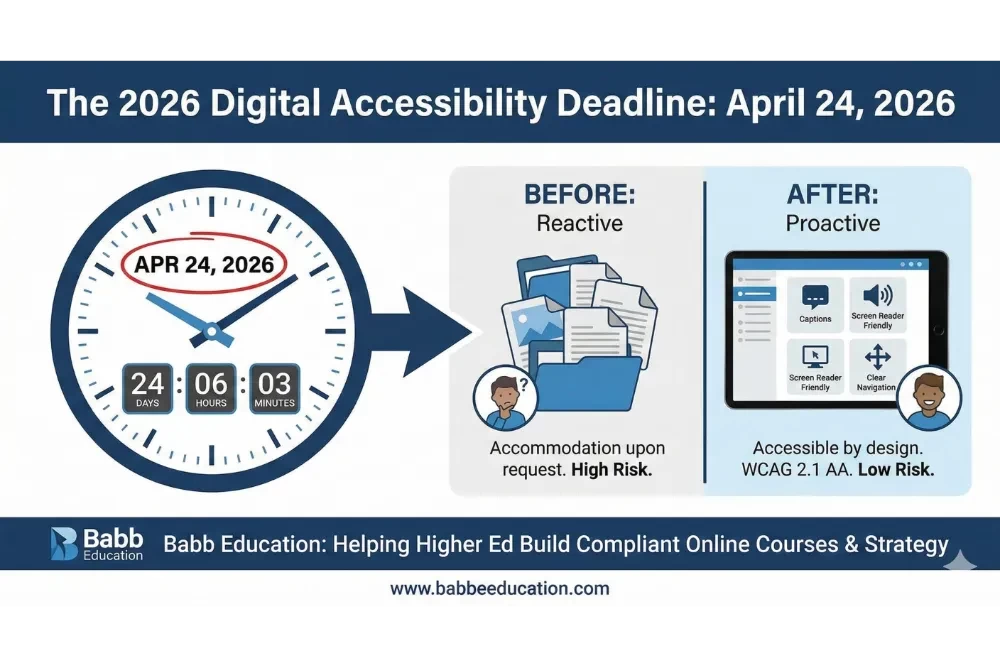
The Compliance Deadline: April 24, 2026
In April 2024, the U.S. Department of Justice finalized new digital accessibility regulations under Title II of the Americans with Disabilities Act (ADA). These regulations apply directly to public colleges and universities, and they fundamentally change how institutions must approach accessibility.
The key shift? We are moving from accommodation upon request to proactive accessibility by design.
Institutions can no longer wait until a student requests an accommodation. All digital content must already be accessible — for everyone — from the start.
What Standards Must Be Met?
All institutional digital content must meet WCAG 2.1 — Level AA (Web Content Accessibility Guidelines). These standards govern usability across multiple dimensions, including:
- Visual accessibility
- Auditory accessibility
- Cognitive accessibility
- Motor accessibility
- Navigation and interface design
Compliance is not optional — and it is not limited to course shells alone.
What Content Is Covered?
Many administrators underestimate the scope of this requirement. Compliance applies to all digital academic content, including:
Course Materials
- LMS pages
- Assignments
- Discussions
- Quizzes
- Syllabi
- Modules
Documents
- Word files
- PDFs
- PowerPoint presentations
- Handouts
- Rubrics
Multimedia
- Videos
- Recorded lectures
- Embedded media
- Podcasts
- Captioning
- Transcripts
Institutional Digital Services
- Department websites
- Student portals
- Registration systems
- Library platforms
- Digital advising tools
Third-Party Tools & Publisher Content
- Pearson
- McGraw Hill
- Cengage
- Wiley
- Labster
- MyLab
- MindTap
- SIMnet
- …and any adopted external platform
If it touches a student digitally, it falls under accessibility compliance.
Why Third-Party Content Is a Hidden Risk
One of the biggest compliance blind spots we see at Babb Education involves publisher integrations and third-party tools.
Many institutions assume: "If the publisher provides it, it must be accessible."
That assumption is dangerous.
Administrators must:
- Require VPAT documentation (Voluntary Product Accessibility Templates)
- Verify WCAG 2.1 Level AA alignment
- Audit platform usability
- Ensure captioning and alt-text compliance
- Evaluate keyboard navigation
Failure to vet external tools still places legal responsibility on the institution — not the vendor.
The Role of DETC (Distance Education & Technology Committees)
Many institutions rely on Distance Education & Technology Committees (DETCs) to guide accessibility initiatives. These committees play a critical role in:
- Faculty training initiatives
- Accessibility policy development
- LMS compliance reviews
- Technology adoption standards
- Vendor vetting processes
- Professional development programming
However, DETCs alone cannot operationalize accessibility campus-wide without administrative support, funding, and staffing.
Accessibility is not a committee initiative — it is an institutional mandate.
What Institutions Should Be Doing Right Now
If your campus has not yet launched a full accessibility initiative, here is an actionable roadmap.
1. Conduct a Full Accessibility Audit
Start with a comprehensive review of:
- LMS course shells
- Program templates
- Institutional websites
- Student services platforms
- Digital libraries
Identify gaps in:
- Captioning
- Color contrast
- Heading structure
- Document tagging
- Screen reader compatibility
2. Train Faculty and Staff Immediately
Professional development is foundational. Recommended training pathways include:
- Internal Faculty Professional Development (FPD) sessions
- ITS accessibility workshops
- Instructional design consultations
- External certifications like WebAIM
WebAIM (Web Accessibility in Mind) remains one of the most nationally recognized accessibility training providers, offering:
- Accessible document design training
- Captioning and multimedia accessibility
- LMS content remediation
- WCAG compliance strategies
3. Redesign Courses — Don't Just Patch Them
Many institutions are attempting quick fixes:
- Adding captions
- Running Ally reports
- Fixing PDFs
While helpful, this is remediation — not design. It will help and it's better than nothing.
Accessibility must be embedded into:
- Course structure
- Navigation logic
- Assignment formats
- Assessment design
- Multimedia usage
This requires instructional design expertise — not just faculty training.
4. Review All Publisher & Vendor Tools
Administrators should require accessibility documentation from:
- Textbook publishers
- Simulation providers
- Lab vendors
- LMS plug-ins
- Assessment platforms
Accessibility must be part of procurement — not an afterthought.
5. Build Accessibility Into Future Course Development
The most cost-effective compliance strategy is forward design. New courses should be built:
- WCAG aligned from inception
- With captioned multimedia
- Screen reader friendly
- Mobile accessible
- Keyboard navigable
Retrofitting old courses can be costly, but must be done. Designing accessible ones from the start is efficient.
Why Institutions Cannot Wait
We are less than two academic cycles away from federal enforcement.
Accessibility compliance is not a "nice to have" initiative — it is a legal requirement tied to:
- Civil rights law
- Institutional funding
- Accreditation risk
- Legal exposure
Institutions that delay action will face:
- Massive remediation workloads
- Budget overruns
- Faculty burnout
- Legal vulnerability
How Babb Education Can Help
At Babb Education, this is exactly the type of work we do.
We partner with colleges and universities to not only build courses, but to:
- Conduct accessibility audits
- Remediate LMS courses
- Redesign programs for WCAG alignment
- Train faculty in accessible design
- Vet third-party tools
- Build compliant course templates or modify classes based on what your internal team found
- Prepare institutions for federal review
Accessibility is not just compliance — it is instructional quality, equity, and institutional protection.
And the clock is ticking.
Final Thought
If your institution has not yet operationalized an accessibility strategy aligned to WCAG 2.1 Level AA, now is the time.
April 24, 2026 is closer than it appears on paper.
If you need guidance, consultation, or full accessibility course redesign support, my team and I are ready to help.